
Better WIP, Better Throughput
Mastering Kanban: Why Board Work in Progress (WIP) Limits Are Your Team’s Secret Weapon


One hurdle that stands out when guiding teams in adopting Kanban is limiting Work In Progress (WIP). Teams resist capping how many tickets they juggle, both individually and collectively. Yet, after more than a decade of refining Kanban implementations, we’ve found that board WIP limits—constraining the total tickets in flight across the team—are the most powerful way to boost throughput and trust. Let’s explore why this practice is so challenging, why it matters, and how to make it work.
The Challenge: WIP Limits Feel Unnatural
New Kanban teams often balk at WIP limits, resisting the shift from juggling multiple tasks at once. The instinct to multitask runs deep, fueled by a culture that equates busyness with value. However, multitasking typically results in slow progress, partially complete features, and diminished user impact. WIP limits—especially at the board level—flip this dynamic, boosting throughput on the most impactful tasks while ensuring they’re delivered with higher initial quality. Focused, high-impact delivery builds credibility with clients, stakeholders, and the team itself, optimizing labor, your ultimate resource, for maximum impact.
What Are WIP Limits, and Why Board-Level?
WIP, or Work In Progress, is the number of tasks actively being worked on. Personal WIP limits might restrict an individual to one ticket, while board WIP limits cap the total tickets on the Kanban board. For instance, on a 10-member team, we recommend starting with a board WIP of nine. When someone finishes a ticket, they check the board: if fewer than nine tickets are in progress, a new item can be pulled onto the board. If not, the team member has “slack time.”
Slack time is intended to be space for collaboration, not idleness. It might mean offering help on in-flight work to teammates—think code reviews or unblocking bottlenecks.
The Payoff: Why Board WIP Limits Work
Board WIP limits deliver three critical benefits:
Team Over Individual Success
Prioritizing the board’s progress fosters accountability and aligns efforts with shared goals. Tickets don’t stall in review or testing limbo—everyone is incentivized to clear them.Quality Through Focus
Multitasking kills efficiency. Limiting WIP ensures high-quality delivery without rework, builds momentum, and reduces back pressure1.Trust Via Predictability
Regular progress strengthens confidence—internally and externally. A steady cadence proves your team’s reliability.
So why the resistance?
The Pushback: Ego, Busyness, and a Misunderstanding of Queuing Theory
Two cultural traps fuel reluctance:
Individual Output as Identity
Many tie their worth to personal throughput, viewing teamwork as a burden. This can spark competition, especially when helping less experienced peers feels like a detour.The Busyness Illusion
A packed plate signals productivity, even if it’s just thrashing. Slack time threatens that image despite being essential for collaboration and team progress. Busyness can also be an easy way to feel empowered to say no to more tasks.
Misunderstanding Queueing Theory
While these cultural traps are typically a large part of the resistance, the most critical challenge is misunderstanding what drives efficiency. Many team members believe that efficiency comes from multitasking. For instance, they may break their day down as follows for a week:
2 hours on Task A
4 hours on Task B
1 hour each on Tasks C & D
In executing this way, they believe they are moving the ball forward incrementally for all four tasks, keeping all four clients happy. In practice, this approach is less efficient. Kanban draws heavily from Little’s Law:
where L is WIP, λ is throughput, and W is lead time (the average time to complete a task).
By multithreading their effort through four simultaneous tasks versus executing them sequentially, they are worst off in all metrics outside of busyness. If we were to accept one new task for each completed item (let’s assume those are average tasks, like Task A), we quickly see how more WIP bogs down delivery:
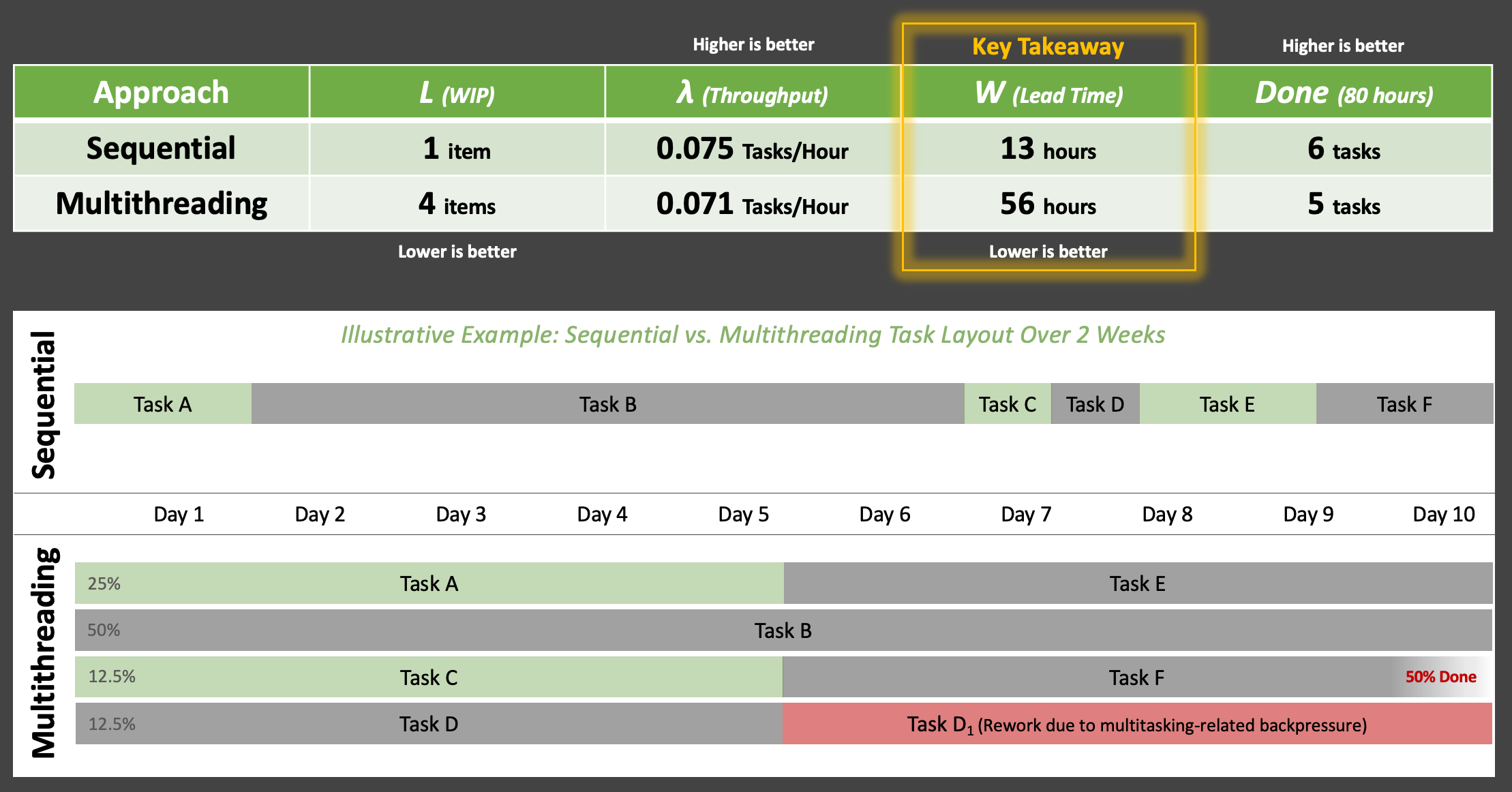
Multitasking more WIP takes longer to complete all four original tasks. Delivery time and trust built by delivering early also suffer, especially when considering how long the client must wait to see and validate progress.
This example is just one resource. When this same effect is multiplied by more resources, the dichotomy grows. With board WIP, having an extra resource (or more) available to help others further enhances the benefits of focusing on one issue at a time while bending the delivery curve for those tasks by having help available when needed. Kanban thrives on small batches and fast cycles—success comes from finishing, not starting.
How do you know if your team could use less board WIP? A good indicator is if you have tickets lingering in “waiting” statuses (e.g., review, testing). That’s a sure sign of silo focus over collective wins.
Making It Stick: Practical Steps
To embed board WIP limits effectively:
Cap Personal WIP
Start with one ticket per person to teach focus and flow.Set Team WIP Below Headcount
For a 10-person team, aim for 8 or 9 tickets. This keeps collaboration alive and prevents gridlock.Decompose Work into Short, Outcome-Focused Tickets
Small, demonstrable tickets reduce complexity, allow for faster feedback cycles, and build customer confidence. Aim for ticket cycle times of at most a week. Even complex, exploratory data science work may be decomposed into bite-sized tickets with outcomes that maintain momentum towards a larger goal.Add a Kanban Board Expedite Lane
Handle urgent tickets with a strict WIP limit (ideally one). When it’s active, everyone rallies to clear it fast.Reframe Slack Time
Position it as a strength—time to refine quality and accelerate delivery. Use metrics like cycle time to prove it.Shift Mindsets
In retrospectives, reinforce that helping a teammate finish is as valuable as starting your own ticket. Slack tasks—low-priority work you can pause—fill true downtime without derailing commitments.
The Result: Turbocharged Teams
Board WIP limits aren’t just a tactic but a cultural pivot. They challenge heroics and busyness, replacing them with focus, quality, efficiency, and collective success. The payoff? Faster throughput, fewer bottlenecks, and delivery so reliable it builds trust across the board.
Next time your team resists, lean in. Show the data, celebrate the wins, and prove that less chaos unlocks more potential in Kanban.
Related Board WIP Limit Notes:
Paired Programming: We regularly encounter teams that want to benefit from paired programming patterns. Limiting WIP is a fantastic way to achieve the desired outcomes of paired programming as it layers in slack time to help with pairing - not just for coding, but throughout the entire SDLC.
Small Teams Need Not Apply: We sometimes hear, “My three or five-person team can’t give up a WIP item.” That’s sometimes fair on smaller teams. Set your limit to equal the number of team members on smaller teams. You’ll get all the same benefits without having a personal WIP greater than one.
One Ticket Isn’t Realistic: For most team members, it is realistic. However, for some senior team members with management responsibilities, multi-tasking is an unavoidable reality at some level. In these cases, smaller tickets help. Embracing servant leadership qualities is often critical as well. If you are split five ways, focus on helping others first and pick up tasks off the critical path.
Back pressure is when Kanban flow slows or stops due to accumulating tasks. It is frequently triggered by juggling multiple tasks, thinking one of those tasks is done, and then finding out it was flawed or requires significant rework. By committing to an additional task too early (and thus setting an expectation for when it might be completed), rework quickly clogs the system, causes delivery delays, and erodes trust in the team. It frequently incentivizes shortcuts to meet delivery dates or at least lessen how late a delivery becomes. These shortcuts typically result in even more back pressure over time, compounding challenges further.